
Reels , Rows and Payline Structure
Chicken Road runs on a standard five-reel, three-row grid with 20 set paylines. You can’t modify the amount of lines, so your full bet is the coin value multiplied by 20, per spin. Wins pay for three or more matching symbols on neighboring reels, beginning from the leftmost reel on defined paths. This fixed-line structure means there’s a base stake, which directly affects your gamble strategy. A tiny 0.5x total-bet win can be enticing to gamble, but if you lose it, the net loss for that spin cycle feels worse because you already placed the full 20-line stake. The wild chicken lands more often on reels two, three, and four, which enhances your chances of multi-line wins when a wild hits in the middle. Multi-line wins that include a central wild often pay out a aggregate payout that’s bigger, so the half-gamble option becomes more viable—even if you miss one colour guess, you might still have some win left if you halt after doubling.
Bankroll Management and Session Strategy
Integrating the gamble feature into a bankroll plan turns Chicken Road into a structured exercise. A practical split allocates 80% of the session bankroll to base-game spins and mentally earmarks 20% as the maximum aggregate win value that can be forfeited to failed gambles. With a 500-unit bankroll, you accept up to 100 units of accumulated wins may be surrendered to the feature. This prevents a single lost gamble on a large win from consuming a excessive share of returns. Setting a hard stop on consecutive gambles also aids: a rule such as no more than two successful gambles in a row before collecting protects against the gambler’s fallacy. Time-based alternation functions too—if aggressive gambling has generated no significant multiplier after 30 minutes, shift to collecting all wins for the next 30 minutes to readjust. Bet sizing correlates with this plan. Players who want to gamble aggressively should lower base bet to allow more spins and thus more gamble opportunities, rather than raising bet and hoping one large gamble bails out the session. Patience and repetition favor this approach.
The Betting Feature Detailed
The gamble feature kicks in after any winning spin below the eligibility cap. You choose to collect or press the gamble button. Stage one demands a card colour prediction—red or black—with a correct guess doubling up the win and a wrong guess forfeiting it. If the colour guess wins, Chicken Road, stage two presents a suit prediction among four options; a correct suit guess quadruples the already doubled win, while a wrong suit guess loses everything. You can quit after either stage and collect the multiplied amount. A standard 52‑card deck gives a 50% chance for colour and 25% for suit. The expected value of a colour gamble equals the original win because (2 × 0.5) + (0 × 0.5) = 1. The suit gamble after a colour win also has expected value equal to the doubled amount. The feature is mathematically neutral; it doesn’t affect the house edge but dramatically boosts variance. This insight should underpin all gamble strategy: the feature is fair in probability, but any single outcome is binary and irreversible.
How to Play Chicken Road Stage by Stage
Begin by opening the game and reviewing the paytable, symbol values, and feature rules, since various software versions might adjust free spin parameters or gamble caps. Set the total bet by changing coin value, noting that the displayed total equals coin value times 20. A bankroll of 200 units at 1 unit per spin provides 200 spins, a sensible session length for medium-high volatility. You can spin manually or configure autoplay with loss limits matched with a session stop‑loss. When a win takes place, the game halts and illuminates the gamble button; if you fail to act within a few seconds, the win is auto-collected. Deciding to gamble means choosing red or black for the colour round, then choosing whether to collect the doubled amount or move on to the suit guess. At any point, collect guarantees the current amount. Free spins activate automatically with three scatters and run without additional bets. During free spins, the same gamble decisions come up after each winning spin, and you must maintain predetermined thresholds intact despite increasing multipliers.
Practical Exercise: Simulating Gamble Decisions
You can assimilate gamble strategy without risking real money by running a mental simulation. Set a assumed bankroll of 500 units, a bet of 1 unit per spin, and a collection threshold of 5x. Replicate 50 base-game spins using a plausible win distribution: 60% produce zero, 25% produce 0.5x to 2x, 10% produce 2x to 5x, and 5% produce 5x to 15x. For each win at or below 5x, flip a coin to mimic the colour gamble; heads multiplies by two the win, tails loses it. For doubled wins still below the threshold, voluntarily flip again for suit with 25% success. After 50 spins, determine net result and compare to a no-gamble control scenario. Repeating this exercise ten times uncovers the variance brought by the feature: some sessions demonstrate profit boosts from successful gambles, others show deeper losses from failed gambles wearing away base returns. The exercise also illustrates threshold effects. Increasing the threshold to 10x sharply reduces gamble attempts and lessens feature impact; lowering to 2x renders the feature control outcomes. This purposeful practice cultivates intuitive risk-reward comprehension and equips consistent strategy execution when real money is on the line.
Main Gameplay Elements
A round begins by choosing the total bet with plus and minus controls, then pressing spin to start the reels in motion. Reels slow down left to right, increasing anticipation as columns lock. Successful combinations on active paylines flash and award into the balance; multiple line wins are summed before the gamble button activates. Autoplay performs a preset number of spins with optional loss and single‑win limits, but it pauses whenever a win triggers the gamble feature, demanding an active choice. The dynamic paytable displays payouts in currency units for the current bet, although the underlying maths employs multipliers. For example, five chicken wilds on a line award 500x the line bet, which equals 25x total bet because each line receives one‑twentieth of the stake. Three scatter symbols anywhere give a payout and activate free spins, which use the same reels but may add a roaming wild or win multiplier. This base loop is simple, but the constant gamble button after every win turns each spin into a mini‑decision point.
The Barnyard Theme and Visual Design
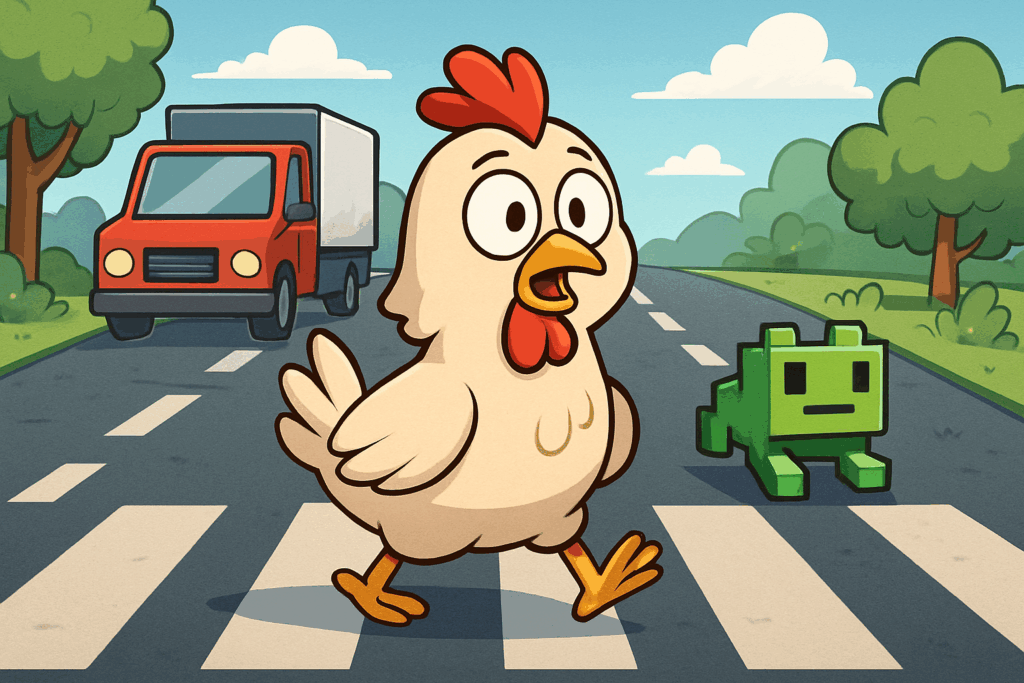
Chicken Road opts for a playful farmyard look—a wooden barn frame, a dusty lane vanishing into cornfields. The palette features warm yellows, rustic browns, and sky blues, which brings the screen a cozy atmosphere that stands in stark contrast with the medium-high volatility running beneath. You’ve got the chicken wild, a rooster, a grain sack, a farmer’s hat, a cart wheel, and painted plank card royals. The chicken wild pays the most and replaces all regular symbols except the scatter. Win animations are quick: a short banjo jingle fires off, a few feathers burst, and the gamble button lights up immediately next to the spin button. The paytable shows dynamic currency amounts for your current bet, so you won’t be left guessing whether a win is worth taking a chance on. That clarity counts when you’re forming a strategy, because the gamble option is never out of view and the interface keeps visible a payout figure. The farm theme frames the gamble mechanics without diverting your focus from the risk decisions you really have to make.
Psychological Traps of the Betting Feature
The gamble feature takes advantage of several cognitive biases. deze gids The near-miss effect takes place when you lose a suit gamble after correctly guessing the colour; the brain reads this as “close” rather than a 25% shot missed, producing an urge to try again. The correct response is to treat the two gamble stages as independent events with no carry-over momentum. Illusion of control leads players to think they can predict the next card colour based on previous results, despite the independent random draw. Some adopt superstitious patterns like always picking red after a black loss, which has no mathematical basis. Loss aversion hits harder in the gamble feature because you actively risk a guaranteed win; watching a 20x win disappear on a wrong colour guess seems worse than losing 20 spins, though the monetary loss is identical. This can push players to abandon strategy entirely or double down recklessly. The game’s upbeat audio after gamble wins boosts risk-taking through a dopamine loop. Acknowledging these emotional pressures is as important as understanding the maths. Players who monitor their own feelings and follow pre-set rules will gain more value over time.

Approach for the Gamble Feature
Efficient gamble use requires a fixed threshold and exit condition for every win. For medium-high volatility, a practical threshold is to gamble wins equal to or below 5x the total bet, because such wins happen regularly and losing them won’t wreck a session. Wins above 10x total bet should generally be collected, since the base game seldom delivers them and a failed colour guess on a 15x win can cause an permanent drawdown. The two-stage structure adds a second rule: after a successful colour guess, stop unless the doubled amount still remains below the threshold. Chasing a suit guess with a doubled 2x win to reach 8x is justifiable; risking a doubled 20x win to chase 80x is reckless because the 75% loss chance wipes out a uncommon base-game event. Bankroll segmentation counts: a player with 200 units betting 1 unit can gamble more boldly than one with 50 units. Allocating a fixed number of gamble attempts per session—say five—and stopping after exhaustion avoids tilt spirals where you chase losses with the next win.
Typical Pitfalls to Steer Clear of While Using the Gamble Feature
The most damaging error is employing the gamble feature to recoup from a losing streak. A player that loses ten spins and then achieves a 3x win often is inclined to gamble it to regain losses, overlooking that each gamble round has a fixed 50% loss chance no matter prior outcomes. Another regular mistake is wagering wins above the session’s average payout. If typical base-game wins vary from 0.5x to 3x, a 15x win is an anomaly; hazarding it on a coin flip with no edge is mathematically poor. Players also concentrate on the 4x suit multiplier while overlooking the 75% loss risk. A disciplined approach treats the suit gamble as an discretionary second stage only when the doubled amount is still minor relative to bankroll. A more subtle error is neglecting to consider for session duration: every gamble round takes up time, so gambling every win reduces base-game spins per hour and warps perceived volatility. Finally, some players turn off the gamble feature entirely, which is a valid preference but gives up the only tool to enhance wins beyond the base-game cap. The best path is selective gambling with pre-set limits.
Additional Bonus Features and Symbols
Beyond the gamble mechanic, Chicken Road includes a golden egg scatter that triggers free spins with three or more in any position on the reels. Three scatters typically award 10 free spins, four grant 15, and five unlock 20, with instant scatter payouts of 2x, 10x, or 50x total bet in turn. During free spins, a progressive multiplier frequently increases by one after each spin, starting at 1x with no upper limit for the feature duration. This multiplier affects all free spin wins, and the gamble feature stays active after each of those wins, letting you to double or quadruple already multiplied payouts. Some versions also expand the chicken wild to cover an entire reel during free spins, boosting multi-line win probability. The combination of expanding wilds, rising multiplier, and gamble option generates a compounding effect where modest free-spin wins can snowball into session-defining payouts. Discipline still remains: a 50x win with a 5x multiplier already equals 250x total, and gambling that on a colour guess risks erasing the likely best outcome of the session.
Adapting Strategy for Diverse Session Goals
Gamble strategy should shift based on player objectives. An entertainment-focused player wanting maximum playtime chooses a high collection threshold around 8x to 10x and gambles only the smallest wins, maintaining bankroll and increasing free spin trigger chances. A multiplier hunter ready to accept higher risk lowers the threshold to 3x and sticks to gambling every eligible win through at least the colour stage. This raises the probability of hitting 20x or 40x payouts from modest base wins but accelerates bankroll depletion. Bonus hunters participating to meet wagering requirements should review terms carefully, because gambling wins could nullify bonuses or cause confiscation. If permitted, they should gamble only very small wins to avoid prompting large withdrawals that could be flagged. A disciplined profit-taker sets a session win goal, such as 20% of starting bankroll. The gamble feature then turns into a tool to reach that goal faster when a win falls just short. If the goal is 100 units and balance sits at 90 after a 5x win, gambling that win to reach 10x achieves the goal in one decision; a loss simply resumes base play. Aligning strategy with session purpose eliminates ambiguity and halts the feature from becoming a random impulse button.
Wager Range and Highest Win Potential
The stake range starts at 0.20 credits and goes up to 100 credits per spin, with coin value set in fixed steps. Because 20 lines are locked, a 0.01 coin value wagers 0.20 total, while a 5.00 coin value totals 100.00. That range caters to casual players who prefer lengthier play and big spenders chasing higher absolute amounts. The primary game maximum win excluding the gamble feature is usually set at 1,000x the total bet, attained by covering the screen with chicken wilds. The gamble feature can drive wins further until a hard cap, often fixed at 5,000x stake or a specific cash value. That cap matters strategically: if you currently have a win near the limit, more gambling is pointless because the game will not pay beyond it. Bet size also affects gamble psychology. A 0.20 bettor earning 2.00 faces a varied emotional call than a 50.00 bettor earning 500.00, even though the colour guess odds stay at 50%. Tailoring bet size in relation to your bankroll, not pursuing losses, is the essential pre-gamble discipline.
Contrasting the Gamble Feature with Other Slots
Chicken Road’s gamble feature falls within the card-based risk style but is notable through its two-stage structure and incorporation with medium-high volatility. Many slots feature a single colour or suit guess, while Chicken Road connects them, enabling a win be doubled then quadrupled in quick succession. This generates a wider range of possible outcomes from one base-game win. Relative to ladder-gamble features, where you ascend a multiplier ladder with escalating loss risk at each step, the card-guess format delivers fixed, transparent 50% and 25% probabilities that are easier to incorporate into strategy. Ladder odds are often opaque. Another differentiator is that Chicken Road does not restrict the number of consecutive gamble attempts per win; you could in theory gamble a win, collect, then gamble again on the next spin immediately. Some competing slots limit the feature to one attempt or a maximum multiplier, lessening strategic depth. The existence of the gamble feature during free spins with a rising multiplier is unusual and brings complexity: a 10x win during free spins at a 3x multiplier yields 30x after a colour win, whereas the same gamble in base game yields only 20x. Thresholds should shift upward during free spins accordingly.
Understanding the RTP and Volatility Profile
The mathematical return sits at 96.1%, an average figure calculated over millions of spins and all bet sizes. Individual sessions stray sharply from that number, so it only sets a extended expectation. What matters more for near-term play is the medium-high volatility classification. The game mixes frequent small wins between 0.2x and 2x the total bet with longer dry spells, occasionally broken by larger line hits or successful gamble runs. This volatility profile directly shapes how you use the gamble feature. In a low-volatility slot, you could gamble small wins freely because the base game steadily tops up your balance. In Chicken Road, cold streaks can deplete a bankroll quickly, so losing a rare 5x win on a failed colour guess hurts a lot more. The gamble feature doesn’t alter the programmed RTP; it reshuffles payouts into higher peaks and deeper troughs. If you track session results, you’ll see that variance obviously, which reinforces the need for selective gambling instead of constant gambling.
Technical Findings and Equity
Chicken Road’s wagering feature runs on a verified RNG ensuring each card draw is unrelated and evenly distributed. Software providers present RNG and gamble logic to external testing laboratories, which confirm displayed odds match actual probabilities over millions of trials. The colour gamble truly provides 50% success, the suit gamble 25%, with no concealed bias or adaptive difficulty. The feature does not adapt to player behaviour or compensate for losses. Fairness certification matters because some players believe gamble features prefer the house more than base game, but expected value is the same: the house edge stays built-in in base-game RTP, and the gamble feature only reshuffles wins without changing long-term return. A technical nuance is whether the game uses a freshly shuffled deck each round or a progressively reducing shoe. If depleted, probabilities shift marginally as cards are removed, but the effect is insignificant within a single session. The game’s help file usually details the method. The maximum win cap applies after all gamble rounds; attempting to gamble near the cap may be blocked or capped, lowering incentive. Checking exact cap values before high-stakes sequences is essential. This transparency lets analytical players trust the feature’s fairness and focus on strategy.
כתיבת תגובה